2. Book the Workshop
All PSI workshops must be booked at least three weeks prior to the date of training using the form below.
If you have an idea, special circumstance, or request, please contact psidworkshopbooking@bctf.ca to book Professional and Social Issues (PSI) workshops.
215: Le Estcwicwéỷ Honouring the Children buried at the Kamloops Indian Residential School
(3 hours)
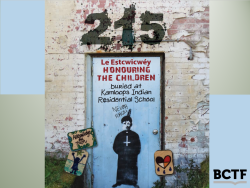
Teachers recognize how important it is to ramp up the teaching of Canada's once hidden history of Indian Residential Schools. In this workshop we will explore how to deepen and expand our awareness of the ongoing revelations of Canadas's policies. This workshop provides participants with the opportunity to build knowledge and confidence in sharing sensitive topics at age-appropriate levels relating to the 215, to have a deeper understanding of the hidden history and legacy of Indian Residential Schools and to develop strategies through reflection, dialogue, and action towards building allyship.
BC Blanket Exercise: Exploring Historical Relationships between Indigenous and non-Indigenous Peoples
(2-3 hours)
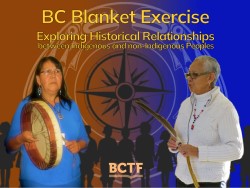 This experiential workshop will help participants understand how colonization of the land we now know as British Columbia and Canada has impacted the people who lived here long before settlers arrived. Through this exercise participants will explore the nation-to-nation relationship between Indigenous and non-Indigenous peoples in Canada, how this relationship has been damaged over the years, and how we can work toward reconciliation.
This workshop is only available in-person.
Canadian Geographic Indigenous Peoples Floor Map of Canada
(2-3 hours)
 Join us for a workshop to explore the Canadian Geographic Giant map showcasing Indigenous communities, residential schools, reserves, and more. Rather than political borders, Canada is broken up into Indigenous language groups. Learn about the diverse voices and stories of Indigenous Peoples and gain a deeper understanding of the past, present, and future. Discover how to incorporate this resource into your teaching to benefit your students and in connecting with Indigenous communities and organizations in your area. A teachers' guide also accompanies this map.
This workshop is only available in-person.
Decolonizing
(3 hours)

In this session members will engage in conversations around colonialism at many levels. Colonialism systemically permeates education, media, government policy and our whole society. Creating awareness is essential to understanding alternative value systems and how we are complicit by inaction. Decolonization demands a close look at Indigenous perspectives, ways of knowing and being and making change in our personal and professional lives.
Deconstructing Myths
(3 hours)
In this workshop participants are submerged into the depths of the mistruths that have made up the belief systems of mainstream Canada for far too long. Participants will be challenged to dig deeper through research, which must include historical documentation and oral testimony as opposed to acceptance of archaic misinformation and hidden fabricated narratives. In a commitment to the continuation of the work that teachers started with the Truth and Reconciliation Commission of Canada, BCTF invites all teachers to join in the effort to seek truth through the deconstruction of myths in curriculum.
Disrupting Anti-Indigenous Racism
(3 hours)
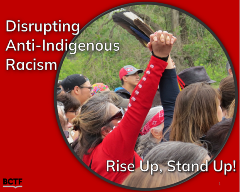
Anti-Indigenous racism is the issue of our time.
Calls to cancel Canada Day were music to the ears of Indigenous Peoples across Canada. The history of colonization in Canada was based on stealing the Land and developing social-political attitudes that justified theft and abuse. COVID-19 has given us the opportunity to look squarely at the racism responsible for marginalizing First Nations, Metis and Inuit, Residential Schools, impoverished reserves, the Sixties-Millennial Scoops, Boil-Water Advisories, Murdered and Missing Indigenous Women and Girls, environmental degradation and more. The outrage we feel over the recent police killings of innocent young men and women are not new, but people everywhere are paying close attention and demanding justice. This workshop will explore this history and energize the movement to end the ongoing genocide.
Education for Truth and Reconciliation: Using the Aboriginal Lens
(3 hours)
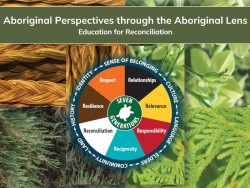 This workshop will explore the seven “R” concepts of the Aboriginal Lens, help educators challenge the current Eurocentric practices that have silenced other ways of knowing and being, discover ways to apply the lens in a variety of circumstances, and highlight the importance of evolving our practices and demonstrating commitment to educating for reconciliation.
Gladys We Never Knew Cross Curricular Lesson Modules for Secondary Schools
(3 hours)
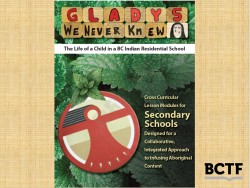
The short life and tragic death of a BC residential school student
The curriculum requiring the infusion of Aboriginal Content and Perspectives now includes Grade 10. Gladys lost her life at the age of 12 in the Kamloops Indian Residential School. The spirit of Gladys is at the heart of this workshop that provides a cross-curricular module of lessons for teachers who want more ideas to help meet the ministry mandate. Like the intermediate module, participants will have the opportunity to engage with the activities and speak with the module developers. The goal of the session is to provide teachers with the resources, background and support that will prepare them to take their students to a deeper level of truth and reconciliation education. This is a developing e-book resource.
Gladys: The Life of a Child in a BC Residential School
The short life and tragic death of a BC residential school student
An elementary and middle school teaching resource
(3 hours)
 Somebody’s sister … somebody’s auntie … somebody’s daughter …
Designed for the intermediate grades, this teacher and student-friendly, ten-lesson module was written with the New BC Curriculum in mind. While learning about the true-life story of Gladys, a local Aboriginal girl from the Nlaka’pamux Nation in Spuzzum, BC, students are taken on a local, land and place-based journey of inquiry and ethical judgement. Students are encouraged to connect personally to Gladys as they work together to examine and evaluate a wide range of primary and secondary resources. The goal of this session is to provide teachers with the resources, background and support that will prepare them to take their students to a deeper level of truth and reconciliation education.
This workshop is only available in-person.
Grad Requirement: Improving Our Practice (Focus: First Peoples English with applications to BC First Peoples 12)
(half-day or full-day)

The new Indigenous Grad requirement offers teachers both opportunities and challenges. This workshop is crafted to help educators enhance their practice. Participants will receive a toolkit filled with practical strategies and resources to engage learners and encourage activism. We invite you to bring your questions and share your success stories. The workshop is available in both half-day and full-day formats.
Infusing Aboriginal Content and Perspectives
(3 hours)
 While teachers express interest in incorporating more Aboriginal content in their classrooms, they are sometimes unsure of where to start and how to find authentic materials. This workshop is designed to create awareness around integrating Aboriginal perspectives and quality Aboriginal resources in the classroom through hands on activities.
Project of Heart
(90 minutes)
 Project of Heart is an inquiry-based, hands-on, collaborative, intergenerational, artistic journey for seeking truth about the history of Aboriginal people in Canada. This teaching resource examines the history and legacy of Indian residential schools, commemorates the lives of the thousands of Indigenous children who died as a result, and prepares students to engage in social justice activities that contribute to the developing truth and reconciliation movement.
This workshop is only available in-person.
Secret Path
(3 hours)
Experience the story of Chanie Wenjack, the 12-year-old boy who perished fleeing from an Indian Residential School in order to find his way home. Teachers will learn how they may bring the music, animation and graphic novel produced by Gord Downie and Jeff Lemire, supported and endorsed by the Wenjack family, to their later intermediate and secondary classrooms as a means of teaching about residential schools and the important role of being an ally. Every Canadian should know Chanie Wenjack’s name and his story.
Sixties Scoop
(3 hours)
This workshop invites educators to open their hearts and minds to understanding the colonial impact of Canada’s history on Indigenous families and their children. Educators will be challenged to unlearn the history taught to them and relearn how to value the lives of Indigenous peoples. Educators will follow the lead of Indigenous educators who may be directly connected to the lived experience of the generations of ‘stolen children’.
Their Voices Will Guide Us
(3 hours)
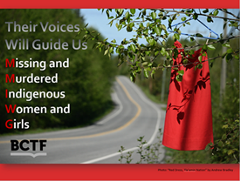
This workshop builds knowledge around the topic of Missing and Murdered Indigenous Women and Girls (MMIWG), while reviewing historic events leading up to the National Inquiry into Murdered and Missing Indigenous Women and Girls final report. Educational resources such as Their Voices Will Guide Us are introduced as well as awareness to The REDress Project initiative.